
Is that image really a deepfake? The line drawn in plain English
A still photo is a deepfake only when three things are true at once: deep learning generated or altered it, it depicts a real and identifiable person, and it shows that person in a moment that never happened. Miss any one of those and you have something else. A Photoshop composite. A filter selfie. A picture of a face that belongs to nobody. The word gets stretched over all of them, which is exactly why a working rule is useful before you share, report, or panic.
What a deepfake photo actually is
Start with the definition the rest of this test leans on. A deepfake is a highly realistic but fake image of a person doing or saying something they never did. The University of Virginia's information security team frames it the same way: an artificial image generated by deep learning that depicts someone saying or doing what they never actually said or did.
That word deep is not marketing. It points at deep learning, a form of machine learning built on neural networks with hidden layers. The more hidden layers a network stacks, the deeper it is. Those layers study huge amounts of data and learn to produce real-looking but invented photos. So a deepfake image is, plainly, a photo created or manipulated using AI through deep learning.
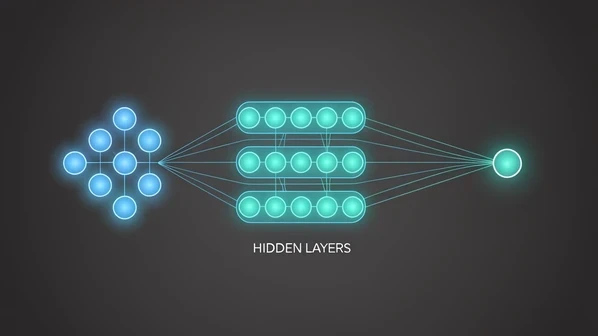
The three criteria that make a photo a deepfake
Turn the definition into a checklist. An image has to clear all three lines to count.
- Generation method: deep learning produced or reworked the image. Manual cut-and-paste editing does not qualify, however convincing the result.
- A real target: the picture shows a specific, identifiable person whose appearance the model learned from many samples.
- An event that never happened: the person is doing or saying something fabricated, not something they actually did.
Proofpoint puts the mechanism well. A deepfake is a prediction engine that learns from a large sample of a target's audio, video, and images, then generates novel content matching those patterns. Read that closely and the three criteria fall out of it. The engine needs a real target to learn from. It produces new content, not a recombination of existing pixels. And deep learning, not a human hand, does the predicting.
Notice what the criteria do not mention: how good the image looks. A crude deep-learning fake of a real senator still qualifies. A flawless AI portrait of a person who does not exist does not. Realism is not the test. Generation method plus a real target is.
Deepfake vs Photoshop vs face-swap filter vs generic AI image
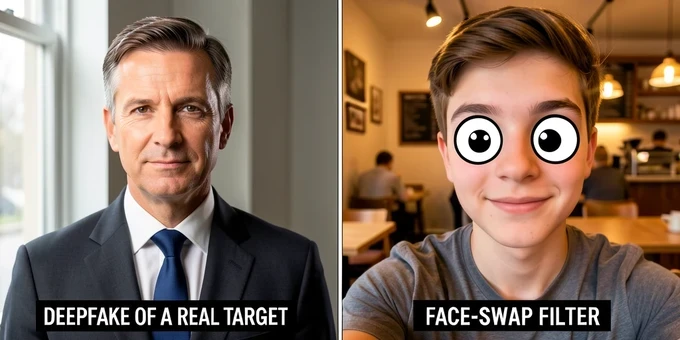
Here is where most confusion lives, so take the look-alikes one at a time. A Photoshopped image or a Snapchat face swap is usually obviously fake and harmless. You can tell. A deepfake applies deep learning, and that is the difference that matters: the output is convincing enough that humans often cannot tell it is fake. Same surface goal, a manipulated person, but a different engine underneath and a different level of deception.
Worth saying clearly, because it trips people up: deepfakes existed before generative AI. Some early ones were straight Photoshop jobs. Others changed nothing in the image at all and simply swapped the caption to imply a false context. The modern deep-learning generation is what distinguishes today's deepfake from those older tricks.
Then there is the case people get backwards most often. A generic text-to-image portrait, a smiling face that looks like a real headshot, is synthetic media. But if that face belongs to nobody, it targets no real person, and it is not a deepfake of anyone. Synthetic media, as MIT Sloan describes it, swaps a person in an image with another person's likeness. No real likeness, no deepfake. The picture is AI-generated and still fails criterion two.
| Image type | Made by deep learning? | Targets a real person? | Deepfake? |
|---|---|---|---|
| Deepfake of a public figure | Yes | Yes | Yes |
| Photoshop composite | No | Yes | No |
| Snapchat face-swap selfie | No | Yes | No |
| Generic AI portrait of no one | Yes | No | No |
| Real photo, false caption | No | Yes | No |
Run the side-by-side in your head. A fabricated image of a real public figure endorsing a product, built by a model trained on thousands of their photos, clears all three lines. A goofy face-swap selfie from a phone app fails the first: no deep learning, just a quick overlay. Only one is a deepfake, and it is not the funny one.
Why the line keeps blurring
The old advice was to look for glitches. Count the fingers, check the ears, find the melted background. That advice is fading fast. Today's deepfakes capture subtle details like skin texture, eye reflections, and natural lighting, which is why judging one is now about questioning what you see rather than spotting obvious flaws, as AIorNot puts it. The tells got harder to find because the models got better at hiding them.
How much harder? In one study, people identified deepfake faces at roughly chance level, about 50 percent, reported by Science News. A coin flip. That number reframes the whole problem. If your eyes perform no better than guessing, then "it looks real to me" carries no weight, and neither does "it looks too real to be fake." Realism stopped being evidence in either direction.
Generative AI lowered the barrier so far that making a convincing deepfake is now easy and cheap. The skill and the studio time that once gated this work are gone.
One more myth worth retiring while we are here. People assume a photo with no content-credential metadata must be authentic, or that a missing C2PA tag proves manipulation. Neither holds. Not every generator writes that metadata, and stripping it is trivial, so an absent content credential tells you nothing about whether AI touched the image.
Why the distinction matters
Getting the label right is not pedantry when the volume looks like this. The number of deepfake files found online grew from roughly 500,000 in 2023 to an estimated 8 million in 2025, according to Proofpoint. That is not a trend line, it is a wall of content arriving faster than any person can vet by hand.
The money tracks the volume. In 2025, U.S. deepfake fraud losses topped $1.1 billion, more than triple the $360 million lost the year before, again per Proofpoint. Behind those figures sit concrete harms: fake celebrity endorsements built to run scams, political misinformation, and explicit images crafted without the subject's consent. The Polish entrepreneur Rafal Brzoska discovered more than 260 deepfake ads on Meta's platforms featuring him and his wife, a single victim multiplied hundreds of times over.
This is the practical payoff of the three-criteria test. Call a harmless filter selfie a deepfake and you cry wolf. Wave past a real deep-learning fake of an identifiable person because "it is probably just Photoshop" and you miss the scam. The definition is the difference between a false alarm and a missed one, and at 8 million files a year, you will face both.