
Build a deepfake AI influencer whose face never changes
Start by locking one identity, then reuse it forever. With deepfake and face-swap tech you have two paths: an AI Clone that turns your own photos into a single recurring face, or a fully generated persona you define from scratch. Whichever you pick, the trick is the same. You stop generating a new character every time and instead feed the same seed into every photo and video, so the face, the voice and the lip-sync stay recognisable across the whole feed. Everything after that, base footage, motion control, disclosure, the legal line, hangs off that one locked identity.
What 'an AI influencer with deepfake technology' actually means
An AI influencer is a computer-generated virtual persona that behaves like a human influencer on social media, posting, replying, taking brand deals, building a following. The deepfake part is not a gimmick. It is the engine that keeps that persona looking like one person instead of a slightly different stranger in every upload.
Here is the core challenge, stated plainly: maintaining a consistent face and identity across every photo and video is the whole game. Lose it and the audience stops believing there is a person there at all. Two routes get you a reusable identity. The first is an AI Clone built from your own photos. The second is a fully generated persona, a face that never existed, locked so it repeats.
- AI Clone path: upload your real photos, and the system learns your face so it reappears across scenes you own outright.
- Generated-persona path: invent the look, no real person involved, then pin it down so it does not mutate.
- Both treat deepfake as a persistent identity layer, not a one-off party-trick swap.
Step 1 - Lock the identity (clone your face or generate a persona)
This is the step competitor guides skim. Get it right and the rest is logistics. The AI Clone path on The Influencer AI turns your own photos into a consistent influencer that keeps the same face across photos, videos, reels and try-ons. You upload, it learns, the face comes back every time you ask for it.
Prefer a face nobody can trace to you? Take the generated-persona route. Before you generate a single image, write the brief: niche, name, age, backstory. A 24-year-old Lisbon-based fitness creator who only posts at golden hour is a far easier identity to keep consistent than 'a pretty woman'. Pick traits or upload reference photos, define who she is, and only then start producing.
Once the identity holds, batch. The point of locking a face is that you can generate a whole content library in one sitting, dozens of stills and clips that all read as the same person, rather than crafting one post at a time and praying the look survives.
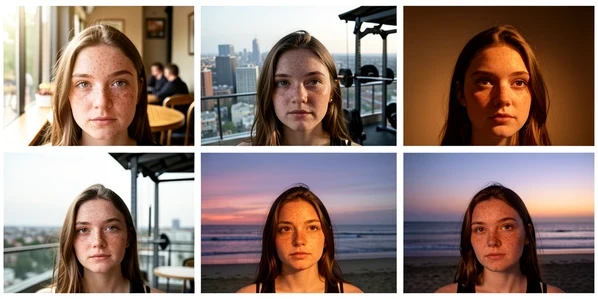
Step 2 - Face-swap onto base footage and keep more than the face consistent
Now the video workflow. Generate or source base footage, a body moving, talking, walking, then swap your locked face onto it. On MakeInfluencer.ai you create the AI character in the builder, generate video with one of 10+ models, then add lip sync and motion control so the mouth tracks the audio and the body moves on-identity instead of floating.
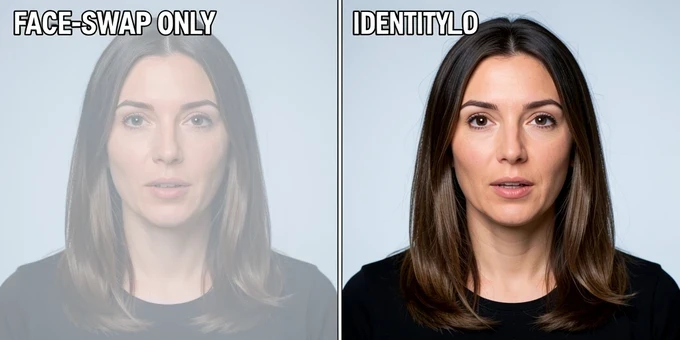
And here is the complaint nobody warns you about. Face-swap-only keeps the face and lets everything else drift. The hair restyles itself between takes, the body shape shifts, the expression resets, the voice wobbles a semitone. Why? A bare swap only constrains the pixels inside the face mask. It has no opinion about the hairline, the shoulders, or the timbre of the voice, so those re-roll on every render.
Constrain the rest deliberately. Lip sync ties the mouth to a fixed voice track. Motion control pins how the body moves. Lock voice and hair as part of the identity, not as an afterthought you bolt on once the clip already looks wrong.
Step 3 - Keep the face from changing every prompt (consistency engineering)
The number-one pain in every community thread: the face changes on every prompt. The fix is mechanical, not artistic. Reuse the same clone or persona seed for each generation instead of re-prompting a fresh character from scratch. Re-prompting from zero is how you end up with sisters, not one influencer.
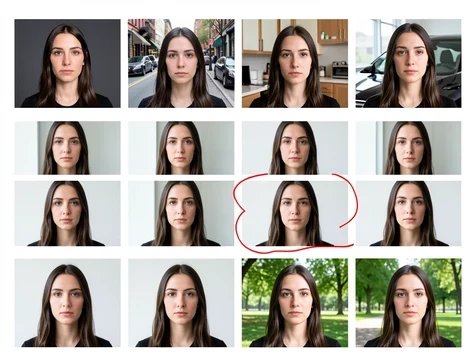
Volume helps you spot drift early. The Influencer AI lets you batch up to 32 photos per prompt across 5 aspect ratios, so a single run gives you a coherent spread of the same face in portrait, square and landscape at once. Generate the batch, then do a side-by-side consistency check before anything goes near a posting queue.
- Fix the seed: every image and clip draws from the one locked identity, never a re-described character.
- Run a batch wide, up to 32 photos and 5 aspect ratios, so you see the face in many contexts in one pass.
- Lay the outputs side by side and reject any frame where the nose, jawline or eye spacing has wandered.
That review step sounds obvious and almost everyone skips it. One off-model frame in a carousel is enough to break the spell.
Step 4 - Pick your tool stack (clone vs persona vs free/open-source)
Choose by the job, not by the marketing. Three jobs matter: lock an identity, make on-identity video, and do both cheaply while you learn. Different tools win each one.
| Job | Best fit | Why |
|---|---|---|
| Lock identity and own it | The Influencer AI (AI Clone) | Clones your photos into one face across photos, videos, reels and try-ons; output is yours forever with full commercial rights; 3-day trial, batch up to 32 photos, 5 aspect ratios. |
| On-identity video with lip sync | MakeInfluencer.ai | Character builder plus 10+ video models, lip sync and motion control, and an MCP connector to generate images and video from inside a Claude conversation. |
| Fast persona-to-video pipeline | Higgsfield AI Influencer Studio | Design a look, turn character and script into video, download ready-to-post, backed by a 25M+ user community. |
| Budget / free practice | Midjourney or Stable Diffusion | Prompt-built characters using an AI avatar generator; iterate on free trials or open-source before paying for a dedicated clone builder. |
On zero budget, build the character with detailed Midjourney or Stable Diffusion prompts and practise on free trials or open-source options. It works. Just know the trade: prompt-built consistency takes far more manual effort than a clone builder that holds the seed for you. If you live inside Claude already, MakeInfluencer.ai's MCP connector lets you generate the images and videos in the same conversation, which collapses the back-and-forth.
Want the persona-to-video step as one motion? Higgsfield AI Influencer Studio is built for exactly that: design the look, feed it a script, download a clip you can post. See the Higgsfield AI Influencer Studio page for the current pipeline.
Step 5 - Disclose and prove provenance before you post
Skip this and you risk the ban, not just a frown. Platforms now expect synthetic media to be labelled, and the rules differ enough that you should check each one against your post before it goes live.
| Platform / body | What it expects |
|---|---|
| YouTube | Disclosure for realistic altered or synthetic content, with in-product labels applied for sensitive topics. |
| TikTok | Clear labels when manipulated or synthetic media appears in ads. |
| Use the Paid Partnership label on brand posts. | |
| FTC / ASA / CMA / FCA | Recognisability: a viewer must be able to tell the content is synthetic or sponsored. |
Labels say what it is. Provenance proves it. Attach Content Credentials and ship the file with C2PA metadata baked in, and apply SynthID watermarking where your generator supports it, so the synthetic origin travels with the asset even after a re-upload strips the caption.
A disclosure caption does not need to be apologetic. Something like: 'Meet Aria, a fully AI-generated creator. This post is AI content and a Paid Partnership with [brand].' That single line plus the Paid Partnership label satisfies the recognisability bar that YouTube, TikTok and the FTC are all reaching for.
The legal line: using a real face, and what to do if you get deepfaked
One rule covers most of it: do not build on a real person's face without their consent. Putting someone's likeness on your influencer without permission can violate image rights and several overlapping laws, and the creator community plus reported cases keep proving the line is real, not theoretical.
Eni Popoola discovered she had been deepfaked when a YouTube ad surfaced using a clone of her face and voice to sell a product she had never endorsed. She gave no consent and got no warning.
Flip it around and the safe path is obvious. Build from your own clone and the output is yours: 'Yours forever. Full commercial rights. Export and use anywhere,' as The Influencer AI puts it. You own the face because it is your face, or one you generated, with nobody else's rights attached.
If your likeness gets stolen, act like Popoola's case demands. Screenshot the offending ad or post with its URL, report it through the platform's impersonation and synthetic-media channels, and keep the provenance trail. Content Credentials on your own genuine posts make it easier to show which face is the authentic one.
Proof it works: real AI influencers and a realistic timeline
This is not speculative. The market is worth more than $32 billion as of 2025, and the named accounts are pulling human-scale audiences.
- Lu do Magalu sits above 8M followers.
- Lil Miquela cleared 2M+ years ago.
- Leya Love holds 500K+.
- Aitana Lopez reached 300K+ on the strength of one consistent, believable face.
Notice what those accounts share. Not a viral gimmick, a stable identity posted relentlessly. The honest timeline is unglamorous: lock the face, build a library, post on a schedule, and let recognition compound over months. A coherent identity and a real posting pipeline carry far more weight than any '$10K/month' headline, which is a marketing hook, not a forecast you should plan around.